Knee physiotherapy in Terrassa
Reviewed by Oriol Martínez Picas, registered physiotherapist (Col. 10224) · Updated
Meniscopathies, cruciate and collateral ligaments, anterior knee pain, Hoffa's fat pad, tendinopathies and muscle tears: specialised physiotherapy in Terrassa.
Conditions I treat
Meniscopathies
Disorders of the menisci (degeneration, small tears or overload) that do not always need surgery. We assess the knee and work on loading, strength and mobility.
What you may notice: Pain along the inner or outer joint line, mild swelling, a feeling of locking or catching, worse when squatting, twisting or climbing stairs.
Meniscal tears
A tear or fissure of the meniscus, often from twisting the knee with the foot planted. Depending on the case, rehabilitation or coordination with the orthopaedic surgeon.
What you may notice: Sharp pain at the joint line, swelling within hours or days, clicking, locking or giving way; difficulty fully straightening or bending the knee.
Collateral ligament tears
Injury to the medial or lateral collateral ligament from a blow or a twist, grade I to III. Progressive rehabilitation according to the grade.
What you may notice: Pain on the inner or outer side of the knee, a feeling of side-to-side instability when changing direction, sometimes bruising and swelling.
Cruciate ligament tears
Injury to the anterior (or posterior) cruciate ligament, typical in sports with changes of direction. Prehabilitation and full rehabilitation, in coordination with the orthopaedic surgeon.
What you may notice: A «pop» or crack at the moment of injury, rapid swelling, a knee that gives way when twisting or braking.
Anterior knee pain
Pain at the front of the knee, often related to the kneecap (patellofemoral syndrome). We work on loading, strength and control of the knee and hip.
What you may notice: Pain around or behind the kneecap when going up and down stairs, squatting, running or sitting for long with the knee bent; sometimes creaking.
Hoffa's fat pad syndrome (Hoffitis)
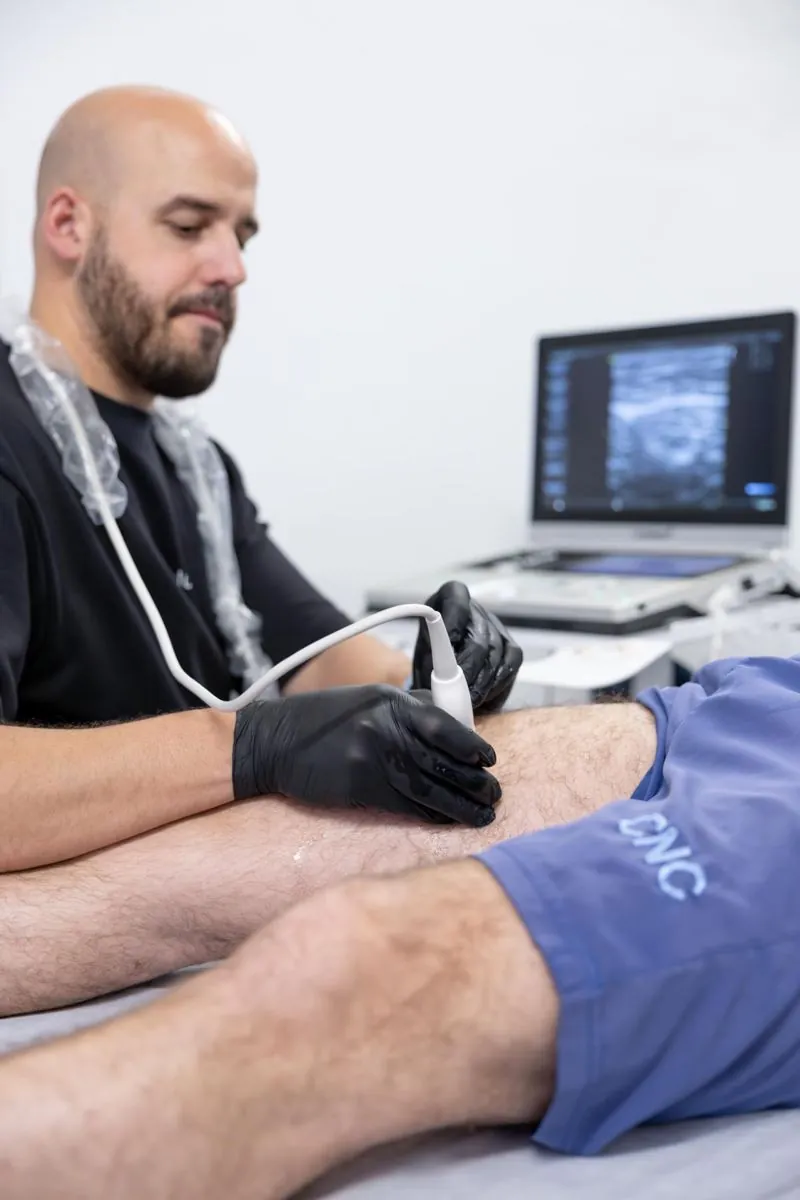
Irritation or inflammation of Hoffa's fat pad, below the kneecap. We assess with ultrasound and adjust loading.
What you may notice: Deep pain below the kneecap, on both sides of the tendon, worse when fully straightening the knee or standing; sometimes swelling.
Patellar tendinopathy
Overload of the patellar tendon (jumper's knee). Ultrasound assessment, EPI and progressive loading.
What you may notice: Very localised pain at the lower tip of the kneecap that warms up with sport and may return afterwards or the next day; worse with jumping and squatting.
Quadriceps tendinopathy
Overload of the quadriceps tendon at the top of the kneecap. Ultrasound assessment and progressive loading.
What you may notice: Pain over the upper pole of the kneecap when climbing stairs, jumping or getting up from a chair; tenderness when pressing.
Iliotibial band
Friction or overload of the band on the outside of the knee, typical in runners and cyclists. We work on loading, hip strength and technique.
What you may notice: Sharp pain on the outside of the knee that appears after a while running or cycling and forces you to stop; worse going downhill.
Tensor fasciae latae
Overload of the tensor fasciae latae muscle on the side of the hip and thigh, related to the iliotibial band. Manual therapy, dry needling and exercise.
What you may notice: Pain or tension at the front and side of the hip and thigh, which may run down to the knee; worse when running or walking a lot.
Quadriceps muscle tears
Muscle injury of the quadriceps, especially the rectus femoris. By severity: grade I (overload or minor strain), grade II (partial fibre tear) and grade III (complete tear or avulsion). We assess with ultrasound and plan rehabilitation.
What you may notice: Sharp thigh pain when kicking, sprinting or jumping, sometimes a feeling of being «hit» or something tearing, bruising and difficulty straightening the knee with force.
Hamstring muscle tears
Injury to the biceps femoris, semitendinosus or semimembranosus, in the muscle belly, at the musculotendinous junction or at the origin on the ischium. By severity: grade I (overload or minor strain), grade II (partial fibre tear) and grade III (complete tear or avulsion). Ultrasound and progressive rehabilitation up to sprinting.
What you may notice: Sudden pain at the back of the thigh when sprinting or stretching, a «stab» sensation, bruising running down the back of the thigh and pain when sitting or bending the knee against resistance.
What it involves
Sports physiotherapy in Terrassa: each plan is tailored to your injury and your situation. First we assess, then we choose the technique.
- Ultrasound assessment of tendons and structures of the knee
- EPI and dry needling for patellar and pes anserine tendinopathies
- Rehabilitation after surgery or a sports injury
- Progressive strength and motor control programme
Conditions in this area
Want me to assess your case?
Message me and I'll book you in Terrassa. Standard visit: €60 (fees).
Book via WhatsApp