TMJ physiotherapy in Terrassa
Reviewed by Oriol Martínez Picas, registered physiotherapist (Col. 10224) · Updated
TMJ disorders, masseter and temporalis tendinopathy, trigeminal neuropathy, meniscal subluxations and bruxism: specialised physiotherapy in Terrassa.
Conditions I treat
Temporomandibular joint disorders
Disorders of the TMJ, the joint connecting the jaw to the skull. We assess opening, movement and the muscles involved and prescribe manual therapy and exercise.
What you may notice: Pain in front of the ear or in the jaw, clicking or creaking when opening the mouth, limited or deviated opening.
Masseter and temporalis tendinopathy
Overload of the chewing muscles. Manual therapy, dry needling and relaxation and control exercises.
What you may notice: Pain in the cheek and temple when chewing or clenching, tenderness to touch, sometimes a temple headache.
Trigeminal nerve neuropathy
Irritation of the nerve that supplies sensation to the face. We coordinate with your doctor and work on muscular and TMJ factors that may contribute.
What you may notice: Sharp, electric-shock-like pain in the cheek, jaw or forehead, which can be triggered by chewing, talking or touching the face.
Fascial involvement
Tension in the connective tissue of the face, jaw and neck. Manual therapy and fascial work.
What you may notice: Diffuse pain and a feeling of tightness in the face, jaw and neck, with very tender spots.
Suboccipital involvement
Tension in the muscles at the base of the skull, closely linked to the TMJ and the neck. Manual therapy, dry needling and exercise.
What you may notice: Tension at the base of the skull, headache starting at the back of the head and spreading forward, upper neck stiffness.
Meniscal subluxations
The articular disc of the TMJ (meniscus) slips out of place when moving the jaw and returns. We work on mobility, movement control and usage guidelines.
What you may notice: A click or «jump» when opening or closing the mouth, sometimes with mild pain; the mouth opens, but the movement is not smooth.
Meniscal dislocations
The articular disc stays displaced and does not return. We assess the situation and work on mobility and pain, coordinating with your doctor or dentist when needed.
What you may notice: Difficulty or locking when opening the mouth, jaw deviation, TMJ pain; sometimes the click disappears once the disc no longer recovers.
Pterygoid muscles
Deep muscles that move the jaw, often involved in TMJ disorders. Manual therapy and exercise.
What you may notice: Deep pain behind the cheek or near the ear and difficulty moving the jaw sideways.
Overload and bruxism
Repeated clenching or grinding of the teeth, especially at night, overloading the TMJ and muscles. Manual therapy, self-care guidelines and coordination with your dentist.
What you may notice: Jaw pain and headache on waking, cheek tension, worn or sensitive teeth, grinding noise at night.
What it involves
Physiotherapy and osteopathy in Terrassa: each plan is tailored to your injury and your situation. First we assess, then we choose the technique.
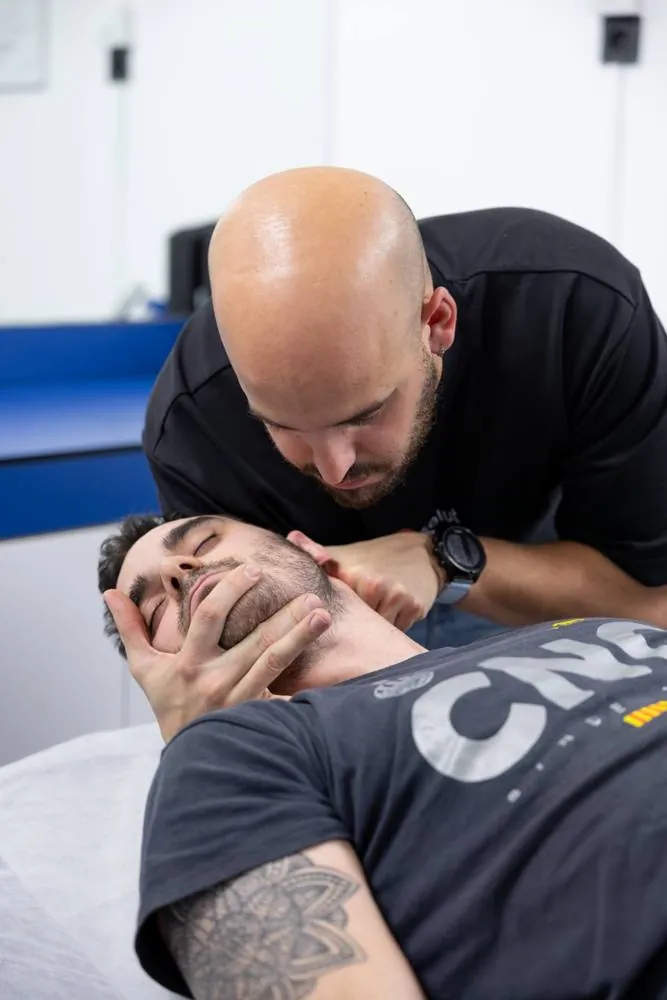
- Functional assessment of mouth opening and jaw movement
- Intraoral and extraoral manual therapy
- Combined approach with the neck area
- Guidelines for bruxism and facial tension
Want me to assess your case?
Message me and I'll book you in Terrassa. Standard visit: €60 (fees).
Book via WhatsApp